822 search results - page 129 / 165 » Comparisons between Human and Computer Recognition of Faces |
164
click to vote
ICPR
2008
IEEE
16 years 8 days ago
2008
IEEE

In this paper, a novel subspace learning method, semi-supervised marginal discriminant analysis (SMDA), is proposed for classification. SMDA aims at maintaining the intrinsic neig...
138
click to vote
OZCHI
2009
ACM
16 years 19 days ago
2009
ACM
This paper extends the analytic framework Suchman used in Plans and Situated Actions by using it as a tool in the design of interactive, immersive environments that rely on human ...
313
Voted
HRI
2011
ACM
14 years 9 months ago
2011
ACM
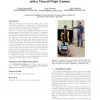
Pointing gestures are a common and intuitive way to draw somebody’s attention to a certain object. While humans can easily interpret robot gestures, the perception of human beha...
161
click to vote
IJCV
2006
15 years 5 months ago
2006
Understanding facial expressions in image sequences is an easy task for humans. Some of us are capable of lipreading by interpreting the motion of the mouth. Automatic lipreading b...
181
click to vote
WEA
2010
Springer
16 years 20 days ago
2010
Springer
A tanglegram consists of a pair of (not necessarily binary) trees T1, T2 with leaf sets L1, L2. Additional edges, called tangles, may connect nodes in L1 with those in L2. The task...