1225 search results - page 96 / 245 » Design Principles for Intelligent Environments |
159
click to vote
GECCO
2007
Springer
16 years 24 days ago
2007
Springer
We explore the use of the developmental environment as a spatial constraint on a model of Artificial Embryogeny, applied to the growth of structural forms. A Deva model is used t...
182
click to vote
GECCO
2006
Springer
15 years 10 months ago
2006
Springer

We propose a new approach to generating the motion of humanoid robots intuitively by means of Interactive Evolutionary Computation (IEC). In our system, novice users are able to d...
187
click to vote
AOSE
2007
Springer
16 years 25 days ago
2007
Springer

Abstract. Agent-oriented methodologies are an important means for constructing agent-based systems in a controlled repeatable form. However, agent-oriented methodologies have not r...
159
click to vote
IJMSO
2007
15 years 6 months ago
2007
: The development of new Information Technologies have originated new possibilities to develop pedagogical methodologies that provide the necessary knowledge and skills in the High...
179
click to vote
AI
2000
Springer
15 years 6 months ago
2000
Springer
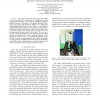
This paper reports the new steps undertaken in our work aimed to demonstrate the effectiveness of an omnidirectional vision sensor when conjugated with the Spatial Semantic Hierarc...