TVT
2016
10 years 3 months ago
2016

Abstract—Multi-user Orthogonal Frequency Division Multiplexing (OFDM) and Multiple Output Multiple Output (MIMO) have been widely adopted to enhance the system throughput and com...
TVT
2016
10 years 3 months ago
2016

Abstract—Simultaneous wireless information and power transfer (SWIPT) has recently drawn significant interest for its dual use of radio signals to provide wireless data and ener...
TVT
2016
10 years 3 months ago
2016

—In this paper, we consider a multiple-input– multiple-output (MIMO) system consisting of one source, one destination, and one eavesdropper, where each node is equipped with an...
TVT
2016
10 years 3 months ago
2016
—In this letter, we consider a cloud radio access networks (C-RANs) in which base stations (BSs) are uniformly distributed inside a disk. The outage probability and the ergodic r...
TVT
2016
10 years 3 months ago
2016
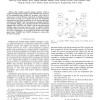
—We consider transmit antenna selection (TAS) in cognitive multiple-input multiple-output (MIMO) relay networks, as an interference-aware design for secondary users (SUs) to ensu...
TVT
2016
10 years 3 months ago
2016

—A Sensor Equipped Aquatic (SEA) swarm is a sensor cloud that drifts with water currents and enables 4D (space and time) monitoring of local underwater events such as contaminant...
TVT
2016
10 years 3 months ago
2016

—In the last decade, vehicular ad-hoc networks (VANETs) have been widely studied as an effective method for providing wireless communication connectivity in vehicular transportat...
TVT
2016
10 years 3 months ago
2016
In this paper, we jointly consider cloud radio access networks (C-RAN) and mobile cloud computing (MCC) in a holistic framework. In particular, we study how to dynamically operate...
TVT
2016
10 years 3 months ago
2016

—This paper addresses the problem of amplify-6 and-forward (AF) relaying for multiple-input–multiple-output7 (MIMO) multiuser relay networks, where each source transmits8 multi...
145
click to vote
TVLSI
2016
10 years 3 months ago
2016

—We propose embedding networks-on-chip (NoCs) on field-programmable gate-arrays (FPGAs) to implement systemlevel communication. Amongst other benefits, this can alleviate the c...