2231 search results - page 165 / 447 » Alternation as a programming paradigm |
104
click to vote
ISCAS
2002
IEEE
15 years 9 months ago
2002
IEEE

Wireless multicast/broadcast sessions, unlike wired networks, inherently reaches several nodes with a single transmission. For omnidirectional wireless broadcast to a node, all no...
139
click to vote
RT
2001
Springer
15 years 9 months ago
2001
Springer
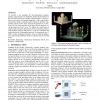
We describe a new paradigm for three-dimensional computer graphics, using projectors to graphically animate physical objects in the real world. The idea is to replace a physical o...
124
click to vote
CCS
1993
ACM
15 years 8 months ago
1993
ACM
Designers of cryptographic systems are at a disadvantage to most other engineers, in that information on how their systems fail is hard to get: their major users have traditionall...
118
click to vote
FSTTCS
2006
Springer
15 years 8 months ago
2006
Springer

Structured Operational Semantics (SOS) is a popular method for defining semantics by means of deduction rules. An important feature of deduction rules, or simply SOS rules, are neg...
124
click to vote
ACL
2008
15 years 6 months ago
2008
We extend the classical single-task active learning (AL) approach. In the multi-task active learning (MTAL) paradigm, we select examples for several annotation tasks rather than f...