197
click to vote
HRI
2006
ACM
16 years 27 days ago
2006
ACM
Autonomous robots use sensors to perceive and track objects in the world. Tracking algorithms use object motion models to estimate the position of a moving object. Tracking effic...
177
click to vote
HRI
2006
ACM
16 years 27 days ago
2006
ACM
Interacting with a domestic service robot implies the existence of a joint environment model for user and robot. To enable robot navigation within such a setting requires further ...
154
click to vote
HRI
2006
ACM
16 years 27 days ago
2006
ACM
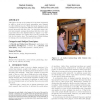
This paper reports on the results of a long-term experiment in which a social robot’s facial expressions were changed to reflect different moods. While the facial changes in e...
169
click to vote
HRI
2006
ACM
16 years 27 days ago
2006
ACM
The paper presents an approach to using structural descriptions, obtained through a human-robot tutoring dialogue, as labels for the visual object models a robot learns. The paper...
200
click to vote
HRI
2006
ACM
16 years 27 days ago
2006
ACM

Programming robots to carry out useful tasks is both a complex and non-trivial exercise. A simple and intuitive method to allow humans to train and shape robot behaviour is clearl...
168
click to vote
HRI
2006
ACM
16 years 27 days ago
2006
ACM
We report a study of a human-robot system composed of a science team (located in Pittsburgh), an engineering team (located in Chile), and a robot (located in Chile). We performed ...
179
click to vote
IROS
2006
IEEE
16 years 28 days ago
2006
IEEE
- As robots become an everyday part of the complicated environment of the human world it will be important for such systems to feature a full body sense of touch capable of detecti...
158
click to vote
HRI
2010
ACM
16 years 1 months ago
2010
ACM

—Humans constantly generate and solve ambiguities while interacting with each other in their every day activities. Hence, having a robot that is able to solve ambiguous situation...
164
click to vote
HRI
2010
ACM
16 years 1 months ago
2010
ACM
—Managing user expectations of personal robots becomes particularly challenging when the end-user just wants to know what the robot can do, and neither understands nor cares abou...